• Skip to primary navigation
  • Skip to main content
  • Skip to footer
Steel Studio
  • Home
  • Services
    • Balustrades
    • Staircases
    • Pool Enclosures
  • Gallary
  • About
  • Blog
  • Contact

General News

Elegant spiral staircase ideas that will transform your home

February 8, 2019 by inbound

Are you looking for spiral staircase ideas for your new home? Our innovative design team gives you the freedom to customise your stair to complement your modern, contemporary or classic home

Your new home has an inviting and open entrance or living space, and you have the space for a sweeping spiral staircase. Where do you start looking for spiral staircase ideas? And how do you find an expert manufacturer that will ensure you get an affordable product that is built to last?
Look no further. Steel Studio’s innovative team is ready to show you that you can achieve a spiral staircase to fit your budget with various material options.

A spiral staircase is a value adding investment for any home and depending on the design and materials chosen could cost you a bit. That’s why you want something that is well built and structurally solid. The last thing you need is a wobbly staircase when you walk on it. There is a skill to creating a structurally sound, quality staircase. A staircase is designed to ensure that you move safely from one level to the next. There’s just no substitute for safety. That’s why you need to go to an expert when it comes to building your dream spiral staircase. You need a company that is reputable and reliable.

Whether you are looking for an extravagant, sweeping spiral staircase, fabricated from high-end materials or a classic, functional spiral staircase, you can trust that we will craft a whatever you need to our highest standards. Our extensive range of customizable spiral staircases is boundless. Our innovative team will design and build the stairs to your specifications or from an architect drawing. However, we also offer a service to help you create your spiral staircase and choose your materials from scratch. We allow you the freedom to choose from an extensive range of materials and components to achieve the stair you want.

Here are some spiral staircase ideas to inspire you.

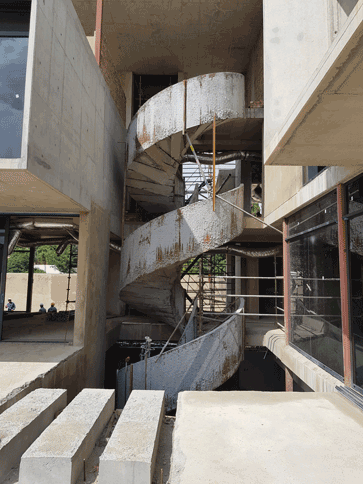
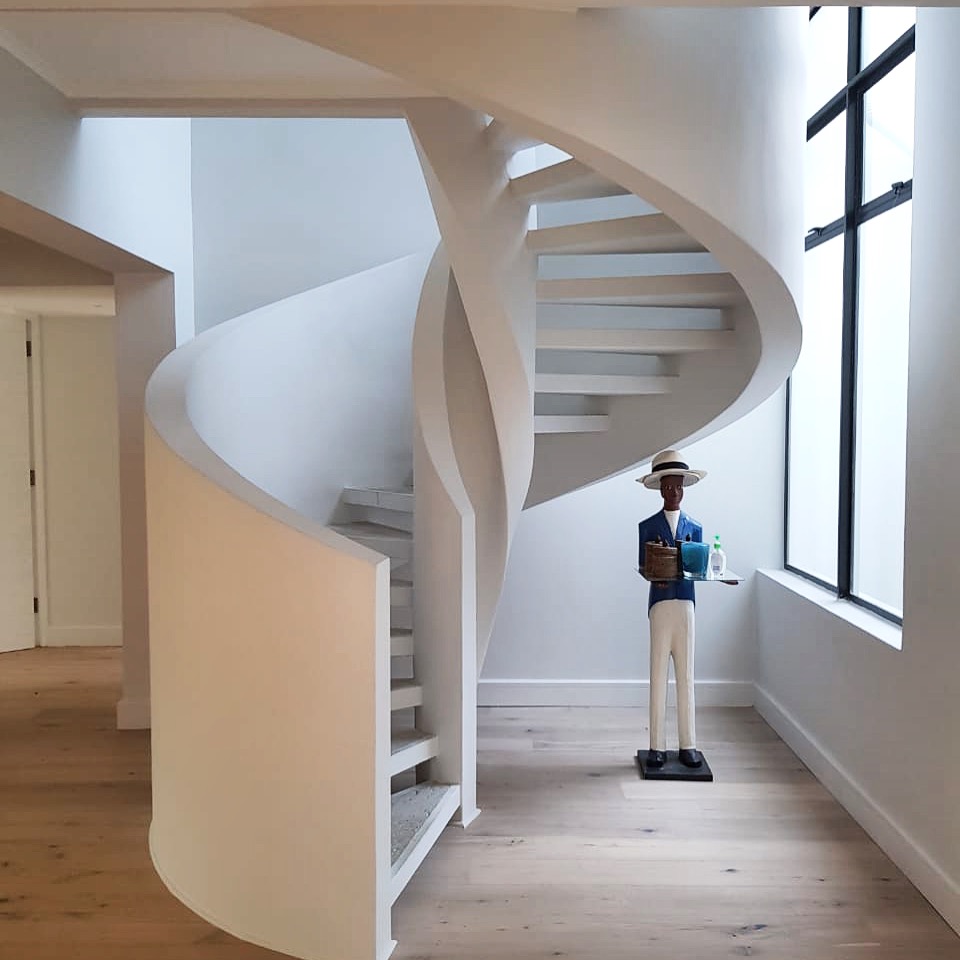
1. A custom concrete spiral staircase with a balustrade wall

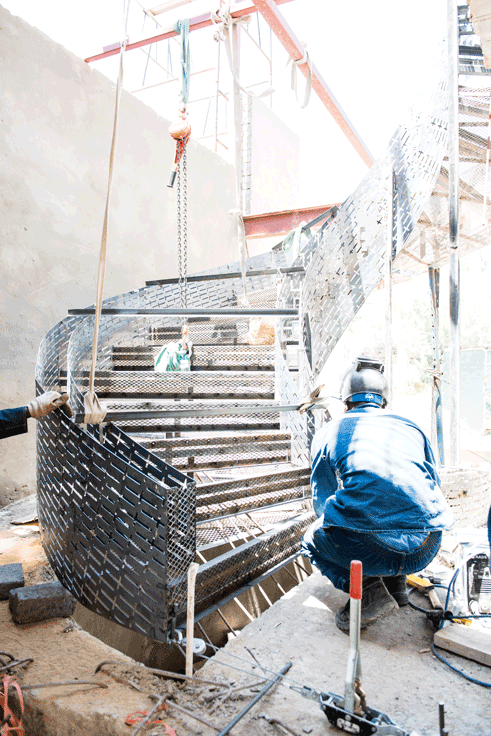
Our team of designers created this staircase for a client who had a tight space but wanted a modern yet affordable spiral staircase with concrete. We fabricated a steel shuttering system for the stairs and filled the formwork with concrete. After that, the stairs was plastered and painted. This staircase complemented the space beautifully.

2. A mild steel spiral staircase with a centre fireman pole

This steel spiral staircase was designed for a two-levelled restaurant. The client wanted a painted structure and matching steel balustrades. A dark, hard timber was chosen for the treads to endure lots of traffic. A centre pole also known as a fireman pole holds the treads and spiral structure together on this spiral staircase.

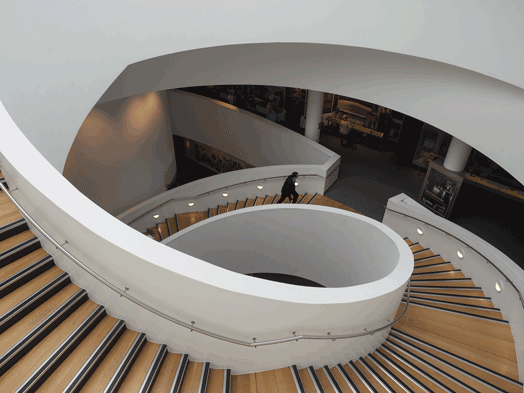
3. A sweeping spiral staircase with timber treads

The brief was for a low maintenance material for the staircase structure with timber treads. We specified stainless steel for the material and also built the rail balustrades from stainless steel. This space offered a large, double volume entrance and a double sweeping spiral was designed and manufactured to fill the space.

4. A stainless steel spiral staircase for an outdoor area

This home required access by an outside pool area. The client wanted an elegant yet low-maintenance spiral staircase because it was right by their entertainment area. Grade 316 mirror polished stainless steel was used to manufacture the structure and the balustrades to prevent damage by environmental elements, and a hard timber was chosen for the treads to withstand rain and sun damage.

What makes Steel Studio experts in building spiral staircases?

  • Material selection and wall-thicknesses for your spiral staircase play a significant role in ensuring that your staircase is built to last a lifetime and also keep you safe.

  • The manufacturing principles of our qualified and skilled artisans provide you with a staircase with structural stability.

  • We ensure that all of our spiral staircase designs are engineered and tested; that is a claim very few manufacturers can make. What does this mean for you? You receive an engineers sign off on completion ensuring the safety of those using the staircase. Leaving you with one less thing to worry about during your building process.

Here’s what you get when you buy a spiral staircase from Steel Studio

  • Your design is done in consultation with a professional structural engineer, and the materials and thicknesses that are used are proven and tested to be of the correct grade and above all, safe.

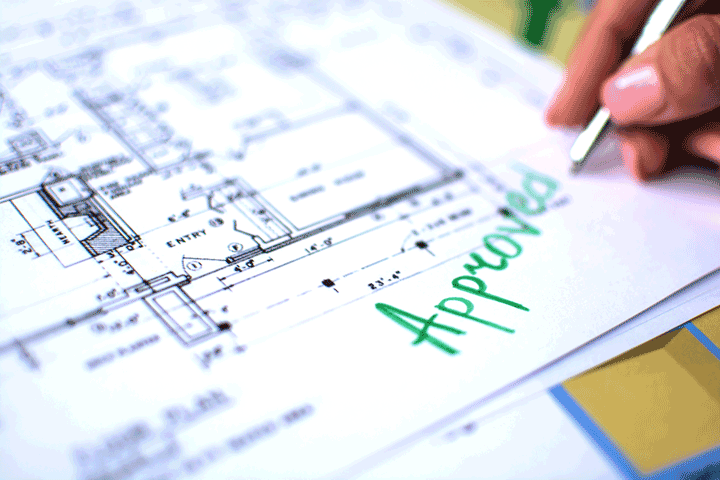
  • Before manufacturing commences, you receive detailed shop drawings and renderings showing you precisely what you’re getting. This enables you to make changes until you are completely satisfied to go ahead.

  • The correct materials and thicknesses are specified and used to manufacture to ensure structural stability. Leaving you with a staircase that doesn’t bounce or wobble when you walk on it

  • You receive an engineer Form 3 on completion which gives you the assurance that your spiral staircase is safe to walk on.

  • We back our products up with our materials and workmanship guarantee.

Our commitment to excellence drives our quality, and that is why we’re held in high regard for our spiral staircases by professionals in the building industry.

Don’t be deceived by poor substitutes and clones that are manufactured from inferior and thinner materials. It will only cost you more in the long run and could risk your safety if it’s not structurally sound or signed off by a structural engineer.

For more spiral staircase ideas for your new home, go to our web page www.steelstudio.co.za /staircases or call us today on 011-608-1963 to speak to our qualified sales executives for a no-obligation site inspection and quote.

PS: Steel Studio also has a range of SANS compliant and compatible balustrades to suit any one of our spiral staircase ideas.

Filed Under: General News

Why Stainless Steel is the right choice for the SpaceX Starship.

January 25, 2019 by inbound

In an exclusive interview with Popular Mechanics, Elon Musk shared how he has changed the construction material of the SpaceX Starship to stainless steel and the reasons why. Steel Studio shares his views on this decision and highlights the benefits stainless steel has to our planet.

In January 2019, the world read about Elon Musk’s decision to build the SpaceX Starship out of Stainless Steel and not out of Carbon Fiber. Here’s a link to the exclusive interview with Ryan D’Agostino, PM Editor in Chief at Popular Mechanics, where they discussed the reasons for this change in material choice.
https://www.popularmechanics.com/space/rockets/a25953663/elon-musk-spacex-bfr-stainless-steel/

The Starship rocket, formerly known as the BFR (Big Falcon Rocket), was initially designed to be manufactured out of carbon fiber. Now, Elon Musk says he’s using stainless steel as the material to construct the rocket.

Historically, there were some unsuccessful attempts in building spacecraft from stainless steel in the late 1950s, but for the first time, this will mark the first successful result that the material will be used to manufacture a spacecraft of this magnitude.

The decision to use stainless steel to construct the Starship.

After rumours of a slight tweak to the design of the rocket, news broke that there would be far more than a simple tweak. The Starship would now be manufactured from 300-series stainless steel instead of carbon fibre. To be precise, 301 stainless steel. If you’re wondering what that grade means, then look around, most stainless steel pots are made from grade 304 stainless steel and so are the stainless steel balustrades that Steel Studio manufactures for inland use.

Why stainless steel is a better option than carbon fiber.

Why are we so interested in Elon Musk’s decision to use stainless steel and not carbon fibre as initially thought? Simple. We share his views in the material selection process. Price plays a huge roll in the manufacturing of the rocket. Where he was paying $135/kg for carbon fiber and wastage was sitting at 35% that couldn’t be re-used after it was cut. He is now paying $3/kg for stainless steel with wastage of 0%. The decision is a no brainer because as we know, stainless steel is 100% recyclable and 65% of all newly manufactured stainless steel goods are from recycled stainless steel. Not only that. But using the highest quality 300 series stainless steel ensures that the rocket is built from a material that is lighter than carbon fiber. It increases in strength by 50% at cryogenic temperatures, whereas other metals become brittle and shatter. It is the high chrome-nickel content in the stainless steel that increases the strength and makes it more ductile. The material is also non-corrosive but also, possesses self-repairing properties, meaning that it self repairs its passive layer under specific strain and damage. This is very much the same reason that Steel Studio uses stainless steel in this series to manufacture balustrades.

Stainless steel remains an environmentally friendly choice.

Above all the reasons described above, the most significant benefit in using series 300 stainless steel is the effect that the material has on our planet. Let’s consider the impact that carbon fiber has on the environment. If 35% of the carbon fiber material sourced for manufacturing the rocket is waste, what happens to that waste, as it cannot be re-used. What percentage of it is recyclable? If any. www.materialstoday.com tells us how difficult it is to recycle carbon fiber. With very high temperatures and or chemicals (adding to the damage to our planet), it is possible to recover the carbon fiber. However, you do risk damaging the carbon fiber in the process.

What should also be taken into account is that upon return of a successful mission, any parts of the rocket, consisting of stainless steel that needs repairs or replacing can be done knowing that stainless steel is 100% recyclable and no scrap will land up in landfills and harm our planet.

We, therefore, back our South African born entrepreneur’s decision to build SpaceX’s Starship of stainless steel, and even though the visible benefits come from the cost, less wastage, and the self-repairing properties of the steel, above all, he is taking care of our planet.

If you’d like to know more about what Steel Studio does, check out our company profile on
https://www.steelstudio.co.za/wp-content/uploads/2019/01/Steel-Studio-Company-Profile.pdf or call us today on +27 011-608-1963 to speak to one of our qualified sales executives.

Filed Under: General News

Custom steel balustrades for a stylish Johannesburg home

January 25, 2019 by inbound

When Steel Studio manufactures a custom steel balustrade that requires precision fabricating and painting, not only is design and quality of importance, but the most important consideration is what effect the balustrade will have on the environment.

In Johannesburg, the latest environmental and equestrian estates often require that the designs of new homes comply with estate rules. These design requirements can sometimes include external finishes like plastering techniques, paint colours, roof designs and often balustrades too. A serious consideration in the process of design is also how the house fits into the environment it is set in and what, if any adverse effects there are to the land it lies on.

A steel balustrade that complies with estate rules and also suits the exterior of a home.

The brief was for a modest steel balustrade design that would blend in with the design of the earthy, yet stylish home. It was important for the designer that the balustrades were customizable to suit the earthy colors and straight lines of the house. A timber handrail was one of the design requirements. A hard wood was chosen for this application to withstand exposure to environmental elements. A custom paint colour was selected to paint the steel balustrade with. However, it was important that a paint product was chosen that would be durable to withstand external elements that would affect the longevity of the steel balustrade but also future contamination to the environment.

What environmental impacts of a steel balustrade installation needs to be considered?

In today’s environmentally conscious world, mild steel as a choice of material for balustrades is often forgotten because it is often harmful to the environment if not manufactured, sealed and maintained with care. Stainless steel has become the balustrade material of choice, due to it’s non-corrosive and self-repairing properties, leaving the environment undamaged, even at the end of its lifespan. The challenge with mild steel is that it needs to be manufactured by expert fabricators to ensure the strength and durability of the system. It also needs to be sealed and painted correctly. Also, the system needs to be adequately maintained to prevent damage, corrossion, and weakening of the balustrade. Once you have a professional fabricator to manufacture your steel balustrades, you need to select a durable and affordable range of paints from your paint supplier that is not necessarily wholly non-toxic, at least it will be less harmful to your environment and yourself. Not only is toxic paint one of the leading causes of human health conditions, especially indoors where air pollution is three times more than that of outdoor air, but landfills are also filled with products that contain toxic paints, which all land up in our groundwater and depletes the ozone.

What should you paint your steel balustrade with?

To paint your steel balustrade, ask your leading paint supplier for a Low-VOC, Zero VOC or Natural paint that will give you good coverage performance, including covering flaws from previous coats. Note that even Zero-VOC paint formulas still contain small traces of toxic ingredients. If you’re concerned about the environment, as you should be, a natural paint that is manufactured from raw ingredients is the way to go. However, you need to ensure that the paint is durable and hard-wearing, especially if applied on exterior balustrades to prevent long term maintenance and corrosion causing run-off into groundwater. The objective is that if you want a mild steel balustrade that needs to be painted that you need to source the best paint you can to protect the environment as best as you can.

How correct maintenance can uphold a steel balustrade.

If a mild steel balustrade is manufactured, sealed and maintained correctly, the damage to the environment is drastically reduced. A steel balustrade needs to be sealed and painted properly with high-quality, non-toxic materials. Not only that, but the precise manufacturing of the system is important to ensure that welding and grinding is ground and polished to a smooth surface that can get sealed and painted.

Assuming that the owner does ensure that maintenance is done to any damaged areas as soon as it is noticed so that the balustrade isn’t exposed to the elements and starts corroding, the environmental effects will be minimized. A steel balustrade that is damaged and not maintained immediately will erode in the damaged area and weaken the system, causing the entire system to be volatile and potentially unsafe.

Steel balustrade as a quality finished and safe product.

After all of the design considerations and product selections, including primers, paints and hard woods, the client of this stylish and earthy home received a balustrade that didn’t intrude on the design of the house or that of the estate. The steel balustrade was primed and painted well in a custom color to suit the earthy tones with minimal exposure to the environment. A hard timber handrail finished off the steel balustrade to complement the natural colors and setting that the home was placed in.

For some design inspiration on steel balustrades, visit our web page https://www.steelstudio.co.za/balustrades/ or call us on +27 011 608 1963 to speak to one of our qualified sales executives for a no-obligation quote.

Filed Under: General News

Innovative electropolishing technique revolutionizes stainless steel balustrade manufacturing forever

January 24, 2019 by inbound

Announcing the latest technology in electropolishing that enables Steel Studio to deliver quality stainless steel balustrades in shorter delivery times at more affordable prices.

In today’s competitive market place, the stainless steel balustrade manufacturing industry must take advantage of as many manufacturing and skill improvements, including innovative, cost-saving techniques that are available to them to stay ahead to deliver a quality product, on time and at affordable prices.

Electro-polishing isn’t new to the industry, but an electro-polishing machine designed explicitly for focused cleaning of tig-welding marks in tight spaces on stainless steel has transformed the manufacturing process and is delivering more significant results in quality and delivery time.

We have taken advantage of this technology to deliver even better quality products to our clients in shorter delivery times at more affordable rates.

What is electropolishing?

Electropolishing is a process also known as an electrochemical process, that removes unwanted material like welding residue from a metallic surface. In simple terms, it polishes or cleans metal. It can be used instead of manual micro polishing with abrasives, to save on expensive labour costs.

Traditionally, a steel component is immersed in a bath of electrolyte or electrochemical liquid solution that often consists of sulfuric acid and phosphoric acid. The solution needs to have a high viscosity. A positive terminal of a power supply connects to the bath, and the negative terminal connects to the cathode. Then, a current passes through the bath, where the surface of the metal is oxidized, producing hydrogen. A reduction reaction occurs on the rough, unwanted surface of the steel component. The rough surface on the steel component dissolves in a process termed anodic leveling. This process is successful only under constant monitoring of the liquid temperature and stable current.

Electropolishing is beneficial for stainless steel because the electropolishing passivates the stainless steel by removing iron from the steel surface and enhances the chromium/nickel content that increases stainless steel’s corrosion resistance. After electropolishing stainless steel, you are left with a smooth surface that is easy to keep clean and sterilized.

Steel objects with intricate shapes and areas that are difficult to reach with other polishing methods are cleaned and polished easily with electropolishing.

How is Steel Studio using the latest technology in electropolishing to improve their stainless steel balustrades?

The original concept of electropolishing has been re-formulated and put into a handheld tool that performs the same function as the bath with electrolyte in with a positive and negative current. During the manufacturing process of stainless steel balustrades, tig welding is the welding process used on stainless steel. The black marks caused by the welding needs to be cleaned off and can be a time-consuming and costly exercise to manually clean with wire brush and scotch brush including the cost of expensive labour.

Now we are using a hand-held electro-polishing machine to remove the black marks from the welded areas on the stainless steel balustrade components. This technique helps us improve the quality of the stainless steel and the end product. With this method, we don’t affect the brushing direction of the material. If you polish the stainless steel component manually, however, you are continually having to ensure that the brush direction of the steel isn’t being affected negatively.

The brush of the electropolishing machine gets dipped into an electrolyte with high viscosity. With the same principles as in the electropolishing bath method, the brush is applied to the welded areas on the stainless steel in gentle backward and forwards motion, keeping your brush wet with the cleaning chemical at all times. A current flows through the brush during the time of application. This process is straightforward and extremely fast. At the same time, consumable usage and labour costs reduce including improved product quality with this technology. On completion, a neutralizing liquid gets applied to a soft wiping cloth, and the leftover liquid gets wiped off, exposing the clean welds, without any black marks from the welding.

This latest innovative handheld electropolishing technology is the type of technology Steel Studio uses to improve the quality of our stainless steel balustrade products, including improved service delivery and as a result, customer satisfaction.

By continually improving our skills and technologies, we can guarantee our quality and above all the safety of our products.

For tested stainless steel balustrade design ideas visit our web page https://www.steelstudio.co.za/stainless-steel-balustrades/

If you’d like a no-obligation quote, call us today on +27 011 608 1963 or email sales@steelstudio.co.za to talk to one of our qualified sales executives.
Filed Under: General News

Steel Studio – The largest balustrade manufacturer in Jhb has a new CEO

December 17, 2018 by inbound

The Johannesburg balustrade manufacturer that’s stood the test of time with it’s cutting edge technology and ingenious designs that are safe above all, has appointed a new CEO to take the company to new heights in design and compliance.

We share with you our loyal supporters, a letter from the Founder – Rob Blackbeard:

“I want to use this opportunity to thank you personally, and on behalf of Steel Studio, for your loyal support and business over the last two decades. It has been a great pleasure to walk this journey with you.

Approximately 3 years ago I decided I would like to relocate to Australia. With that in mind, I started looking for suitable investors to take over the company. As you can understand, the wellbeing of both the staff and customers I leave behind were a very important consideration for me in selecting suitable investors. Towards the end of last year, I managed to conclude a deal where I sold 90% of my interest in Steel Studio to a consortium of investors. The remaining 10% of my shareholding was transferred to the executive directors in the business as a reward for their loyal service over many years, and to ensure their continued commitment to the business.

The transition to new management started early this year and has gone very smoothly, and the future looks exciting. After an initial handover period, Andre Ribbens has been formally appointed as the new full-time CEO of Steel Studio. Andre comes with a wealth of knowledge and experience, having been at Rand Merchant Bank for the past 23 years. Andre is also the largest shareholder in the consortium that bought Steel Studio at the end of last year and he is clearly motivated and incentivized to make sure that Steel Studio remains the leader in the balustrade industry.

I am still heavily invested in the business through an earn-out structure to ensure the new shareholders get the value they paid for. My last day of formal employment with Steel Studio will be the end of November 2018 where after I will remain involved with the business as an advisor and mentor to Andre

personally and also to the broader management of Steel Studio. I am still in South Africa until April 2019, and will gladly still visit clients or sites if required.

I am 100% confident that the service and quality we have always strived for at Steel Studio, will remain unchanged.

I will miss you.

Sincerely,

Rob Blackbeard”

With this next phase for the best balustrade manufacturer in Jhb, we welcome Andre Ribbens to the Steel Studio family and wish him all the best with taking Steel Studio to the next level.

Filed Under: General News

Attention Architects – 3 reasons why Stainless Steel Balustrades is today’s sustainable choice

December 10, 2018 by inbound

By specifying stainless steel as the material of choice for your balustrades, you are making cost effective and environmentally conscious decisions to improve your clients’ long term costs on their project.

  • Stainless Steel balustrades save you money on long term maintenance
  • Start protecting the environment by specifying stainless steel
  • Why the right grade of stainless steel guarantees structural endurance in balustrade systems

In todays uncertain economy, stainless steel balustrades may at first be viewed as an expensive option for building projects, however many architects and consumers fail to realize the long-term, environmentally friendly benefits that offset it’s initial cost by a large margin.

  • Stainless steel balustrades save you money on long term maintenance.
  • The unfortunate reality is that professionals like architects, quantity surveyors, developers and building contractors are driven by price, for understandable reasons and often land up choosing mild steel balustrades in stead for the initial cost benefit to the project in stead of stainless steel balustrades. But, what isn’t taken into account is that mild steel requires regular maintenance, like repairs, sanding, priming and painting. Therefore the initial cost of stainless steel versus mild steel cannot be compared when life cycle costing and environmental impact is taken into consideration.
    Not to mention that if mild steel balustrades are not maintained often enough to prevent corrosion to the system, the system will weaken at the corroded spots and could result in failure, causing serious injury or even death to the user.
    From a sustainability viewpoint a life cycle cost assessment is a very useful tool due to the fact that it assists project managers in making sustainable decisions by identifying and quantifying all costs, initial and ongoing, associated with a project or installation over a given period.

  • Start protecting the environment by specifying stainless steel
  • By choosing stainless steel balustrades instead of mild steel balustrades, professionals are also specifying a material that is 100% recyclable without any loss in quality. These recyclable credentials stem from the fact that during production, the use of scrap metal is a normal part of the production process. In fact, 65% of all stainless steel is produced from recycled stainless steel.
    In addition, stainless steel is not coated with harmful materials and therefore doesn’t produce toxic run-off due to exposure to water and environmental corrosive elements. This means that even if stainless steel isn’t recycled and does find it’s way to a landfill or disposal site, it has no detrimental effect on the soil or groundwater. Mild steel, in comparison, will corrode due to environmental exposure and will need ongoing maintenance, with toxic coating and paints that eventually damage the environment.

  • Why the right grade of stainless steel guarantees structural endurance in balustrade systems
  • At Steel Studio, we highly recommend the specification of stainless steel Grades 304 or with exact comparable properties for inland applications and Grades 316 mirror polished finish for coastal environments for the manufacturing of balustrades, to prevent them from deteriorating and resulting in danger to those utilizing the building.

    From a structural point of view it’s also important to take into account that with stainless steel’s non-corrosive properties, the structure doesn’t become weak (if maintained in the correct manner) in areas that could result in the failure of a key building element like a balustrade system.

    In comparison, mild steel corrodes and if not maintained and repaired on a constant basis, the balustrade could result in weak areas that lead to the failure of the balustrade system. This is extremely concerning given that this type of structure is ultimately a safety element of a building and an accident could result in serious injury. Which really defeats the object of specifying a safety element on a building like a balustrade that complies with the balustrade design regulations at the time that the building is handed over to the client but that might not comply with the structural qualities over time if it isn’t maintained frequently. It is a known fact that the architect or quantity surveyor who initially specified the balustrade on the project, don’t follow up on whether the balustrade is being maintained or not and are unaware of what the effects could be on a deteriorated mild steel balustrade system.
    Overall, stainless steel is the preferred material for green buildings throughout the world given that it’s impact on the environment is minimal when compared to other materials and its environmental impact reduces significantly as it is used and recycled. Companies
    and individuals who are committed to the long-term sustainability and cost saving benefits of this ‘simply brilliant’ material by choosing stainless steel can therefore make a huge difference.

    The really good news, though, is that by specifying the correct grade for your stainless steel balustrades on a building project, you are protecting the environment, saving your client long term maintenance and replacement costs and guaranteeing the structural quality of the balustrade for the rest of it’s life span.

    Find out more about our ‘Saving lives one Balustrade at a time’ campaign here https://insights.balustradesafety.co.za/forms/bf/253 and ensure that you work with professionals when specifying stainless steel balustrades.

    Speak to our team of experts in our residential or commercial sales department to assist you in specifying the right grade of stainless steel for your application.

    Call us on +27 (0) 11 608 1963 or email sales@steelstudio.co.za

    Filed Under: General News

    The balustrade design regulations interpreted by experts

    December 6, 2018 by inbound

    In this webinar, experts discuss the balustrade design regulations in South Africa. A team of experienced balustrade contractors, joined by Craig Thompson, a renowned structural engineer answer questions that the industry and the consumer have with regards to some very contentious issues around safety and installation:

    • What is a balustrade and what is it’s purpose?

    The definition of a balustrade is, it is a structural element that forms part of a building and it is there to prevent the people that are using that building from falling from one level to the next and thus it’s a safety element that will prevent harm or even death in some circumstances. In the attached video discussion, experts and professionals take on this question and unpack the balustrade design regulations behind this structural element that forms part of safety in any building.

    • Why does a balustrade need to comply with SANS?

    Over the last couple of years we have seen an increased number of incidents where there have been serious accidents and even deaths that have occurred due to inferior balustrades installed by unscrupulous balustrade installers, installing systems that do not meet the balustrade design regulations and safety standards. Just to name a few, there was an incident in Umhlanga at the Gateway shopping mall where a six year old child fell between a gap of more than 200mm between the balustrade uprights. Tragically, that child fell to his death. Another incident in Mosselbay where a balustrade that failed a 400 Joule soft body impact test, a teenager also fell to his death. The media has reported very little detail on these incidents and have noted that out of court settlements were taken with no persons taking responsibility for the failure to protect the public and their children.
    When is the industry going to wake up and regulate balustrade contractors and ensure that we are looking after our clients and their safety. The SANS codes very clearly specify that the responsibility lies with the owner of the building for any death or injury that occurs due to a non-compliant balustrade system.
    Together with industry associations and professional structural engineers, Steel Studio has undertaken various measures of trying to educate the industry on the balustrade design regulations. In addition to measures to try and build associations to help us to educate and regulate the industry. Unfortunately we have found this to be very difficult to do with the amount of red tape, corruption and lack of support, when all we’re trying to do is save the lives of our clients and the lives of our clients’ clients.

    • What does the SANS codes say about balustrade design regulations and safety?

    As far back as 2011 the SABS rewrote quite a lot of the codes covering the building industry and they became known as the SANS codes instead of the SABS codes. The main SANS code being the 10400 and the 10160 which talks to the loading requirements on a building project. Prior to this, there have always been regulations basically governing the design and safety requirements of balustrades but not in so much detail and once the new codes were published a lot more attention was placed on what is happening in the industry. In particularly Steel Studio noticed these changes and decided to do the right thing and we needed to make sure that we comply with the SANS codes. Which we did and it’s cost a huge amount of money, time and effort, testing, sample manufacture, consulting with engineers like Craig from Pure Consulting to make sure that any balustrade system that we manufacture, that we quote on and install complies 100% with all of the SANS requirements. There are a multitude of other codes that also talk to various things like fire, people with disabilities, glass in architecture. All of those things have something to do with balustrades in the building codes. Which unfortunately a lot of it falls on deaf ears and people are still kind of doing what they think will fly. So from a responsibility point of view we have taken it upon ourselves to take the SANS building codes and all of the regulations and make sure that our systems comply. At the same time we are trying to assist and educate the industry to try and get everybody to comply with regulation and code. A competent person has to sign off on a balustrade and that competent person by definition is someone that is a registered professional structural engineer.

    • What is the definition of a competent person that is referred to by SANS?

    Craig Thompson elaborates on the gray area that remains in contention around what a competent person is and whether that is a registered professional engineer. “In my opinion, there are glass specialists that are competent glazing specialists. If the balustrade was only glass and merely glass then one could argue that a person with the credentials of a competent person glazing could sign such a thing off but most balustrades have components beyond the glass. They have connections to the floor slab and they have other connections and structural components associated with it, so there are gaps in such a persons’ understanding possibly. I know a lot of competent people that don’t have academic qualifications that are hightly adroit at designing things so I am not saying that qualified by experience isn’t worthy of respect, however the most important thing to say is that for the end user, they would want someone who’s registered, in other words someone who has studied and is experienced in that line and at the end of the day they can put their registration number against that , because that is really the basis of the regulatory system in this country. Whether it is a balustrade or a building structure. Whatever it may be, at the end of the day for the comfort of the occupants, the person who is signing that off has a higher duty of care to society to sign it off. It’s a duty that goes beyond the duty to the project. It’s a duty to society, so essentially that professional person needs to be registered because it’s a higher calling. It requires that level of commitment. That person should be able to speak to an imaginary judge and in the event of a failure, when you ask that person to look at things that maybe aren’t quite engineered correct but they maybe are advantageous to winning the contract. The main thing is about me saying to my own subconscious, well am I doing the right thing by society. Can I justify the decision that I’m making today to this imaginary Judge because one day I might have to sit in front of this imaginary judge and he’ll be a real judge and I’ll be explaining to him, why as the alledged cleverest person in the room I let this decision go by without due consideration and thought and that’s really the just of it. A higher call and duty of care to society”.

    • Steel Studio’s ‘Saving lives one balustrade at a time’ campaign

    This is exactly why Steel Studio has undertaken this campaign ‘Saving lives one balustrade at a time’. To try and educate the public on the balustrade design regulations and actually get people to realise that they do have a responsibility to socienty, including balustrade contractors like us as professionals and as responsible corporate citizens, we all have a responsibility for what we are installing regardless of whether it’s a balustrade or anything else.

    • Who is responsible in the design of a balustrade and who carries the risk in the event of a failure?

    The main question an architect or building professional needs to ask themselves is who is going to take the design responsibility for the balustrade design. Upon receiving a lot of drawings and tenders from architects for various designs, one has to ask yourself what’s the actual design that will comply with the balustrade design regulations? and that’s why we try to reach out to the professionals, to actually set up appointments with them to assist with the design. From our side, we’re trying to make sure that what is actually detailed is a compliant system and inline with the SANS codes.
    Craig comments that “It is advantageous for architects who are highly trained to give their intent in terms of the details when they are looking to procure a balustrade because that is in essence them saying, this is what we’d like it to look like. This is how we believe it could work, but at the end of the day the final decision, the designer, is the guy who gets to decide last. This is really important. The guy who’s the designer of the architectural and the intent drawings. I look at it as intent only. And sometimes an architect may not see it that way and insist that this is what he wants. Yes, it might be what you want, but it might not work. So, how do we get from something that you want to something that works. That is certifiable and can be signed off. My measure of who is the designer, I always say, it’s the guy who gets to decide last! There can be lots of cooks in the kitchen through the process but the guy who decides last is the designer because he’s the one that says the glass has to be this thick, the bolt has to be this big. He’s the guy that gets to decide. People can throw their concepts on the table and those will all get the due consideration. But at the end of the day, they’re really just ideas in the melting pot. But the guy that’s responsible, gets to decide because hes the guy that carries the can”.

    • What is the responsibility of the architect when designing a balustrade?

    The architect and the professional team’s responsibility when designing a balustrade and appointing a contractor should be to look at the basic specification to make sure that it is properly interrogated with the installer and that it’s double checked by a peer engineer to make sure that it complies with the balustrade design regulations and that your client is fully aware of what this balustrade does and what will happen to it if it is impacted whether it will disappear or not. We know clients in the past that have been quite acceptant of just a toughened solution, and then insist on toughened laminate glass simply because they realise that there is a danger if the glass is damaged, it will disappear completely. At least there is an element that remains in place, and might protect somebody for a little bit longer before it falls over. Unfortunately not all professionals are as attuned to the problem as we would like.

    We see it all the time in the enquiries that come through. Steel Studio is a competitive organisation so we are answering enquiries all the time. The level of enquiries are astronomically bad. No performance specification, no definition of occupancy, sometimes specifying down to the last minutely what the balustrade should look like including the thickness of the glass even, sometimes no design as the word mentioned in the enquiry. It’s really hard in that instance to be competing against another tenderer. Because, what do you do? You offer what’s on the drawing but you clearly know it doesn’t work or do you do the responsible thing and design it properly, and not get the work.

    It’s down to the wording of the actual enquiry, design, supply and install and if you don’t do that you are not protecting your client properly. As a professional, if you don’t have the proper wording, you’re actually just placing yourself and your client at risk.
    But every time the discovery of who is the responsible person ends up only being discovered at the end when the installation is complete and there is no responsible designer to the installation and then everyone runs around like a headless chicken, going, “who’s going to sign this off”.

    • The gray area around the word design

    There is a gray area around the word ‘design’. People take it as “well I’ve got design responsibility. It looks very sexy at the end of the day and I’ve done a great job”. The balustrade is a beautiful design. That doesn’t mean that it complies with anything because it’s a great design. The definitition of the word design when it comes to doing a balustrade should incorporate the engineering, the calculations, the testing, the sign off and ultimately the certification. Which leads on to the Form 3 documentation which we all know is needed for occupancy. It’s a compliance requirement. And these days we don’t notice many Form 3’s getting issued by companies, whether it’s a balustrade, a skylight or whatever the case is. But it is a requirement in the balustrade design regulations.

    Craig again comments “I think it is probably due to having watched it happen and seeing it in associated industries. It’s a lack of understanding in the early conceptual side of the job as to who is responsible. That’s why it is really important that when an enquiry goes out depending on whether the project is large or small, make it very clear that whoever is putting that enquiry out ,whether it’s a builder just looking for a quote, or whether it’s a professional quantity surveyor putting out a tender, it’s really important that that enquiry should say the words ‘design, supply and install’. If the word design is missing from that enquiry, then by it’s very nature it’s a supply and install tender or enquiry, so who is responsible for the design and obviously the original intent on the drawing is responsible. Sometimes those original drawings are devoid of any engineering, haven’t been shown to the project engineer that is responsible for the balance of the components on the project and therein lies the gap. The word design in this instance is the structural design of the balustrades. Is it strong enough? Is it stiff enough? Will it be fit for purpose to act as a barrier to stop people from falling to their death.

    • What are the various tests that need to be performed on glass balustrades and why do they need to be performed?

    Going back to the design and touching a little bit on the various tests. What sort of tests does a balustrade need to pass? SANS10160 clearly defines what loading the balustrade has to comply with. But to go back one step, there are clear occupancy categories within the SANS and balustrade design regulations, whether it’s a residential category or an office or a fire escape or in a retail space, each one has it’s own category of test requirements that have to be undertaken for it to deem to pass or deem to satisfy. If you look at table 7 in the SANS codes in 10160 it gives you a clear description of the occupancy categories so if it’s a residential category it then tells you, that the line load, which is a distributed load over a meter of balustrade has to be 0.5kN/m plus a point load which is a load that’s supplied on a 100×100 square element at any point on the balustrade and in any direction. That’s 1kN/m. That covers residential. That is pretty light duty. Then as you go up in categories to retail for example, that is a 1.5kN per linear meter line load which is pretty big. And then all the way up to fire escape stairs and fire escape routes, which are at 3kN/m. That’s 6 times what the residential loading requirements are. That excludes glass. That’s purely the two that we would call ‘static’ loads.

    On glass it calls for the swing bag test, the 400 Joule soft body impact test, which is a 30kg bag of sand swung from a predetermined and calculated height and the glass may not break or come out of its frame. So, if you have a glass balustrade system, which incorporates steel members, with glass panels and it’s going into a shopping centre, for example, it’s got to have 3 tests done. Which is the swingbag test on the glass, and it’s got to have a line load test and a point load test. These tests we know are commonly not happening so, what we’ve noticed is because it’s a design and supply and perhaps a tender document comes out with a design indemnity form that people sign with a flourish and they indemnify the client, the owner, the developer and the main contractor and they hope nothing ever happens and pray nothing ever goes wrong. But they are still not doing the required tests on the balustrade systems, which is a major issue.

    One has to look just a little bit behind what is the reasons for those load levels at the various categories. Firstly these categories exist from an occupancy point of view to govern rules pertaining not just to balustrades, but to fire, to fire escape to all sorts of things that the SANS regulations are linked to, so it’s really just saying that there’s a category of risk called residential, it’s got its associated risk associated with it whether it’s balustrade or whether it’s fire escapes or whatever it might be. Then there’s the retail risk, which is different and then there’s a fire escape risk which obviously has crush loading. In the event of a fire you will have lots and lots of people trying to get down those stairs so there’s going to be people in a crush situation much like a grand stand at a soccer game or a rugby game and so those load levels and those static load levels that were spoke about earlier, those are really like a combination of international norms. They’re a load event that is defined to give a reasonable sense of security that if that barrier can resist those kind of loads it will be strong enough and stiff enough to do the job. So, those static loads that were spoke about earlier, the line load on the balustrade and the point load that were spoke about, and incidently 1Kn is 100kg’s. So just to clarify. The residential codes is 0.5Kn/running meter line load on the balustrade. That will be 50kg a running meter or a bag of cement every meter. And then the 1kN is of course 100kg applied over a 100mmx100mm block anywhere and in any direction. You can demonstrate compliance to those without testing. Testing is one way to demonstrate compliance to balustrade design regulations but because they’re static forces you can as a registered engineer or competent person, you can demonstrate by reasonable calculation that the components in question can do that so, those kind of things can be done by calculation. However, the other category that was touched on, that impact category with the energy, that’s there to mimic someone uncontrollably maybe falling against the balustrade. Someone tripping and falling against something in a dynamic sense.

    That’s not a calculable thing, There’s no engineering calculations that will calculate what that will do to the balustrade. The only way to demonstrate compliance with essentially what is energy is to test it. So, that 400 Joule impact test and the reason the regulation is quite emphatic that it needs to be tested on brittle material like glass, simply because glass is brittle. It’s either there, or it’s not. It’s not a ductile material like stainless steel or structural steel which will if overloaded, bend and bend a little bit more and give you lots of warning and bends even more and eventually it will not even break it will just sort of bend permanently. Glass is not like that. Glass is either there or it’s gone. We’ve all seen the hijackers on the side of the roads breaking the side windows with a spark plug and the glass is broken, that’s toughened glass. It’s a brittle material, so, the intent of that 400 Joule test is about demonstrating to ourselves and to the public, that that balustrade in glass, because everyone wants a ‘look ma, no hands balustrade’, one that you can see through, one that doesn’t get in the way of your sightlines, it leaves you with a beautiful view, that is usually glass. But it’s still a barrier and it still has to do it’s job. So, what happens if someone falls against that balustrade accidentally or runs into it accidentally? Will it still be there to protect that person or will that person fall to their death. 400 Joules is quite a lot of energy. That swingbag that is a leather bag with 30kg of sand inside, we lift it up quite high in a pendulum stroke, We sometimes lift it up to 2 odd meters, and then we let it go like a pendulum clock and that impacts into the glass and the glass has got to stay there. And that cannot be done by calculation.
    These are all tests that Steel Studio has taken on to ensure that everyone of our balustrade systems go through this vigorous set of testing. We have our engineers involved and we take on that responsibility to ensure that we are installing a safe and compliant system. It’s unfortunately the case that there are all of these companies out there that aren’t doing this, and that’s why we’re trying to educate and let professionals and the consumer know what exactly goes into our systems and what should be going into every single balustrade system that is installed.

    • What are the SANS required airgaps on a balustrade?

    Focus for one second on only the airgaps of a balustrade system. The norm is on a residential application, you’re required to have no more than a 100mm airgap anywhere in the balustrade system. A balustrade needs to be a minimum of 1m high. In order for us to achieve that height and the 100mm airgap consistently throughout, we need 8 x 19 diameter rails as infills. We see plenty of other member sizes being used, 12 diameter and 16 diameter. That does not pass the balustrade design regulation and compliance. Due to the permanent deformation of these intermediate rails. It is important to note that the gap between the handrail/toprail and the first infill rail must also comply with the 100mm airgap. On a 7 infill rail system, the gap turns out to be 150mm which is non compliant. The codes are very specific as to what these minimum airgaps should be and yet we continue to see 5, 6 and 7 rail systems out there and sometimes even more scary, 2 and 3 rail systems! Some of the horror stories that we have heard about include incidents where balustrades have airgaps of more than 100mm. You have to look at the intent of the regulation. The intent of the regulation is that the occupant may be an infant, who is not all that together, yet, in their lives. They cannot distinguish danger from safety, and so, the gap of 100mm minimum is there to protect that toddler or infant that may fall through. Like the earlier story of the incident at Umhlanga mall and in Mosselbay. These are all children that have been taken before their time. How much money is a human life worth? Can you put a price on a human life? 5 rails, 6 rails, 7 rails, save 2 rails? Cost someone a life? That’s how you need to look at it.
    But, besides the number of infill rails and having your uprights and handrails engineered, and all the calculations and all the testing done. The key to the whole installation is actually how it’s fixed at the base. Whether it’s into a concrete floor or whatever substrate the balustrade is being attached to, or whether it’s a bolting system. When the balustrade takes it’s load, that load transfers and creates a massive lever arm and all the force happens around the base of the balustrade. There are far too many systems being installed with a simple pin that is being drilled into the concrete and they are finding a product off the shelf at the local hardware and they’re using that as an anchor. This example of an anchor is known as and acts as a hinge. So, we’re expecting a balustrade with a meaty upright that’s required to take the load but we’re expecting everything to hinge on a 10mm or 12mm pin that’s been epoxied into the concrete for example. We also go to great lengths to test every method that we use to fix and our favourite method where possible is the core drilled method where we go in to approximately 150mm into the concrete. We take out the core, We go to 150mm to compensate for screed and tile or whatever they have done to fix the floor levels as is common practice in this country. But then you’re getting a good keep. We’re using a non shrink cementitious grout, which is also key, because you cant have a product that you pour in there and then the grout shrinks and the system is loose.

    If it comes to a mechanical fixing where core is not a practical solution, we then obviously engineer to use whatever bolts or flanges or plates or weld ons that the system may require. If you’re welding a stainless steel balustrade externally in a wet environment onto a mild steel structure you will pick up problems with galvanic action due to two dissimilar materials reacting to each other in a wet environment. A long topic conversation for another day. But the fixing is key here.

    • Are DIY balustrades tested and safe?

    Companies that sell DIY balustrades and kits are not fabricators or manufacturers themselves but they have this whole catalogue and range of products, that don’t comply with any test or balustrade design regulations. But you can go in there with your shopping trolley and buy a whole range of products, walk out, and they’ll hapilly let you go and install a balustrade yourself. Who carries the risk in this situation? The products haven’t been designed. We’ve mentioned before that if youre a company that manufactures bullets for instance and you happily sell to the whole market but you say well I don’t know what they’re going to be used for. You have a liability in that whatever you are selling, should be tested to some type of norm and you should have a responsibility to the public and the consumer to say, what are you using this product for? This is what it has been tested for. This is what it complies to. That is currently not happening with diy balustrade kits!
    Steel Studio is systemised about how we do everything. We know our business. We’ve been doing it for a long time. We have various systems that are our go to systems through the residential market, into the commercial tender market. All of those systems are tried and tested. We have always considered the regulations, we’ve considered the engineering and we’ve done the testing. So, we’re coming from a position that we understand the systems that we are selling. All of the systems whether it be a ductile stainless steel system, where we understand that the intermediate rails cannot be too small or they will just bend to the glazing systems that we will go through.
    The key thing is that Steel Studio has a systemised approach to balustrades, and we know what systems work where and what to avoid, in terms of systems and certain instances and we won’t put the wrong kind of system into an inappropriate application whereas if you’re going to shop with your trolley looking for a diy balustrade, you’re going to make mistakes.

    • Does a point fixed glass balustrade cause reason for concern?

    There are constant concerns raised regarding side fix of glass to slabs. The design criteria that has been come across in the past from various designers seem to fail the tests. And it’s really just fixing the balustrade with a couple of pins onto the side of the slab and there’s no stability to the system.
    This side fixed glass system is probably the hardest balustrade to get to work by calculation. Because slabs are generally quite thin, because the engineer doing the slabs is trying to make them thin. So, when youre fixing to the side of something like that and you’re fixing into the slab with two point fixings, two things are happening. The point fixings are close together because the slab is quite thin and you have to work the point fixing down by the edge distance because the bolt manufacturer will tell you that you can’t put the bolt too close to the edge because otherwise it might break out or break off when you pull it. So you end up with a very small lever between 2 pins, usually in the range of 100mm. So just to keep the magnification thing simple, if you’re pushing something from a meter height, and the magnification between the two is 0.1 of a meter, you’ve got a magnification on the force on that point of 10 times just to start with. Then one has to understand that those point fixings are by their very nature, a point, so, it’s not spread over the surface of the glass like for example a glass in channel which is spread over the full length of the channel. But its localised stresses right at the point where that point fixing is coming off. And there’s holes in the glass right where you’re stressing the glass. So, it is the worst engineering solution and yet it has been in many successful applications, and we’re still battling today to find a structural model that can demonstrate compliance by calculation with some of those things and the only way we have managed to work our way through and understanding what we can certify in regards to the various occupancies we’ve spoken about was to understand the dynamic side of things because the dynamic tests, the 400 Joule soft body impact tests are far more onorous for that kind of application than the static ones, so whilst we have tested those systems intensively for the static, that 400 Joule bag test on the glass is by far the worst load case we could consider. The only way we can get through that process is to understand the dynamics of the thing and how it vibrates when it’s hit and how it interacts with adjoining things. So, does the handrail play a part? Are we able to pin the handrail at some point to assist? Is pinning the handrail helping or is it making it worse for us? Is the handrail infact behaving a bit like a whip? We found that the handrail at times can behave like a whip. Because when you hit one panel of glass and as the glass moves and imagine that the glass is rubber, so imagine in your mind this thing hitting the rubber and you see the handrail vibrating and as it starts to vibrate it leaves glass panels next to it, behind as it moves forward. But then the glass panels behind start to catch up. And so the handrail at the top acts a bit like a whip. In fact, when we thump one piece of glass the adjoining two pieces of glass break, not the one we hit because the handrail at the top, whips the other direction and literally breaks those panels of glass. It has been a tricky design. However the ones that we do certify have gone the test of time with testing with Steel Studio. Obviously glass thickness plays a very important role and glass type.

    There are such anomalies with engineers signing off a balustrade with point fixes because as soon as you impact them they break. A lot of times during the designing period, you first want to have that design and due to it’s failure you go for a normal top of slab in channel situation. It comes down to the actual main structural element of the building that’s not designed to take this balustrade. And if you have the information to make the slab with an upstand or some way to give it depth then you can make this balustrade work.

    Also to understand that it’s a point fixing so the stresses are highly localised at the point whereas a channel is distributed over a longer length. One has to understand that without commercial pressure you would just keep making glass thick enough until it works. But unfortunately in this country we are a little bit of a back water. It’s a wonderful place to live but we only make ordinary annealed glass between 3mm thick and 12mm thick in this country and then we beneficiate that glass by either toughening it which is a bit like the blacksmith toughens the horseshoe by heating and quenching it. It’s a similar process to make it stronger. The cooling effect at the surface of the glass generates a pre-compressive stress in the outer surface of the glass, which means the glass is awful in tension. It can’t carry any tension. So, that pre-compression has to be overcome before the piece of glass breaks. For instance, the side windows of your car is toughened glass, that is a safety glass because when it breaks, the locked in energy of that toughening process, fragments the glass into lots of very tiny pieces. But without commercial pressure we would just make the glass thicker and thicker. Of course, that’s an ideal world because we all live completely in a commercial world so, it’s finding that happy medium between beautiful looking balustrades and commercial balustrades. And that is our dilemma. With those point fixings, we battle. We end up going to thicker glasses than we make in this country, which means the raw material that we are using in the balustrade, is imported at import rates, with duties etc, etc. because we’re ending up with glass thicknesses thicker than 12mm. spigot systems with no toprail, can you just imagine that panel of glass, especially in a retail application, falling from a height, the kind of damage that it could do?

    • Does the regulation insist you have a handrail on a frameless glass balustrade?

    The question always comes up, “is it still possible to have a frameless glass balustrade?, without the installation of a stainless steel handrail”
    Yes, it is possible, but it comes down to the engineering and it talks again about what we were saying earlier. It depends on what the occupancy category is, you can certainly have a glass balustrade without a handrail but it’s probably going to be very very thick glass. If the glass is planted in a continuous channel where the glass is grouted in and is continuous, you’re going to get some load transfer. If it’s a standard side fix glass detail with standoffs that we were discussing earlier, you’re going to have to have super thick glass to get it to pass because then, each panel is acting individually, in an impact situation. There is no assistance from any handrail at all. So, it can be designed to pass, but it is going to be very thick glass. Again, it’s a commercial thing. Essentially the rail at the top helps to share the loads. So, if you push on one panel, the existence of the handrail whether it be point fixed to the glass or capped over the top of the glass, there’s an act of sharing, so if you push on one panel, by vitue of the stiffness of the rail, It’s sharing the load with the panels on either side. So, the rail helps the installation and keeps the glass thicknesses at commercial levels, but yes, in an ideal world again, money aside, no handrail is required in terms of the regulation.

    Does the regulation insist you have a handrail on a frameless glass balustrades?
    No. It is just not economically viable, to install that type of system because you’re really going to have to go so thick on the glass, to borderline bullet proof glass or alternatively plant the glass in a channel to avoid the handrail.
    Handrail options that Steel Studio offer:
    31×31 concave or recessed stainless steel handrail. This is the most popular toprail, small and sleek and really finishes off the balustrade quite nicely.
    We also offer a handrail that sits on a 12mm bent up bracket. We can offer a variation of sizes like a 40 x 40 square, 50 x 30 rectangular and or a 30 diameter or 50 diameter round handrail.

    • Glass balustrade components. Why don’t they work?

    Likewise with your post and glass system, if you’re not using the right clamps, the glass basically just slips out of the clamp. We have even seen in retail spaces where 8mm glass has been in stalled and has slipped through the clamps and is balancing on the floor surface. You have to ensure that the components that you are using have been tested to comply with the balustrade design regulations.

    • Why is the grade and finish of stainless steel so important in balustrade applications?

    In terms of stainless steel grade and finish, we have spent a bit of time in Kzn and have noticed that balustrade companies are installing grade 304 brushed stainless steel material, externally at the coast. It just doesn’t work. You’re not even going to get 2 years life out of it. We doubt if you would get six months life out of it.
    Just something important to notice that if you are using stainless steel for coastal applications or around salt pools, it is important to use a grade 316 mirror polished stainless steel. That is the only spec that can abe used for coastal applications and around salt pools. This also again goes back to safety. If you’ve got a lower grade of stainless steel going in you’re going to have issues with corrosion and you are going to have issues with the safety of that balustrade actually where it may pass the compliance initially, but the system will deteriorate and it won’t hold up over a long time, exposing you to the risk of failure of the system and causing serious injury or even death.

    • Educating the balustrade industry on the balustrade design regulations

    The question is often asked, surely it must be responsibility of the Councils that they check for compliance? Are they issuing a compliance certificate without checking the compliance?
    Yes, It should be. But it isn’t. It is something that we really have been pushing to create that awareness and to better regulate it, but there’s just so much red tape around it, we’ve actually got impatient with it and so now we take it upon ourselves to have discussions like this and to educated the public.
    What we’re wanting to do is try and educate the architects, educate the contractors, and to educate the quantity surveyors, so that they can actually scrutinise these other balustrade companies, to a point where they are not going to be getting those orders if they intend supplying balustrades that don’t comply. They are not going to be getting work for non-compliant, dangerous systems. The fight is ongoing and we continue to advocate for compliance in the industry.

    Filed Under: General News

    A stainless steel balustrade that lasts forever

    November 21, 2018 by inbound

    Here’s why a stainless steel balustrade remains the balustrading choice that protects the environment, is low in maintenance and saves you money

    If you’re in the market for a balustrade for your new building, you have many aspects to consider. How the balustrade material will affect the environment. Whether the product will be low in maintenance. And in today’s uncertain economy, price plays a large role in your decision. Stainless steel balustrades may have been around for over 30 years, but it remains a classic for many reasons.

    The impact a stainless steel balustrade has on the environment

    Simply stated, none. By choosing stainless steel instead of mild steel as the material of choice for your balustrade design, you’re inherently specifying a material that is environmentally friendly. In addition it is also 100% recyclable which has a positive effect on the environment because there is no requirement to extract new minerals from the earth each time you manufacture stainless steel. What’s more is that there is no negative effects to the quality of the material. Stainless steel is not coated with toxic materials compared to mild steel and it will not produce toxic run-off like mild steel does when it starts to corrode due to exposure to water and environmental elements. These toxic run-offs contaminate the ground and water that it is exposed to.

    The life cycle of a stainless steel balustrade

    Due to the non-corrosive properties of stainless steel. When used as the material of choice to fabricate a balustrade, you are ensured of a life time of durability and quality. By using the correct grade of stainless steel for your application, you contractor must be able to prove the origin of the stainless grade and should also provide you with a lifetime guarantee on the stainless steel material itself.

    Why a stainless steel balustrade is low in maintenance

    Stainless steel demands very little maintenance due to its corrosion resistant properties. No corrosion protection is required. When a stainless steel balustrade is manufactured correctly to ensure that welding and drilling is finished to standard, stainless steel balustrades will require a quick and easy wash with a gentle soap and water mixture. The rule of thumb is to wash your balustrade as often as you wash your windows to keep dust and environmental particles from collecting on the rails. It is important however that a contractor is qualified and experienced to work with stainless steel, as the alternative could result in untidy welding and drilling and these poorly finished areas become collection areas for dust and environmental particles to collect in that will eventually cause what is called ‘tea-staining’. This is not rust, but it will require a tougher cleaning regimen and could require the owner to call a balustrade contractor in to fix and clean the untidy surfaces. The challenge is that when stainless steel is fabricated poorly in the beginning, it is very hard to repair it afterwards.

    Why a stainless steel balustrade will save you money

    The initial cost of stainless steel is more than that of mild steel, however when the life cycle of stainless steel and the minimal maintenance costs are taken into account, then a stainless steel balustrade will save you money in the long run. It is crucial for a quantity surveyor to take long term maintenance and life cycle costs into account when budgeting for a balustrade design.

    The safety of a stainless steel balustrade

    All balustrade installations are required by law to come with a Form 3 Engineers sign off to ensure the structural safety of the system. Stainless steel will offer you a life time of safety and durability if it is installed by a professional and if it is designed and tested in consultation with a registered, professional, structural engineer. Although, if a mild steel balustrade is specified at the beginning of the project and the balustrade contractor supplies a Form 3 Engineers sign off for the installation, it is crucial that ongoing checks and maintenance are done to the mild steel balustrade as corrosion will undoubtedly affect the structural quality of the balustrade system and if not maintained properly could result in failure of the balustrade, causing serious injury or even death. It is very important to consider the maintenance and the costs thereof when buying a mild steel balustrade because of the initial saving on the project. No maintenance to a mild steel balustrade will result in failure of the balustrade.

    Now that environmental concerns, maintenance and price has been addressed, there is nothing stopping you from having the latest design in a stainless steel balustrade for your new building.

    Here’s what one of our recently satisfied clients have to say about their balustrades:

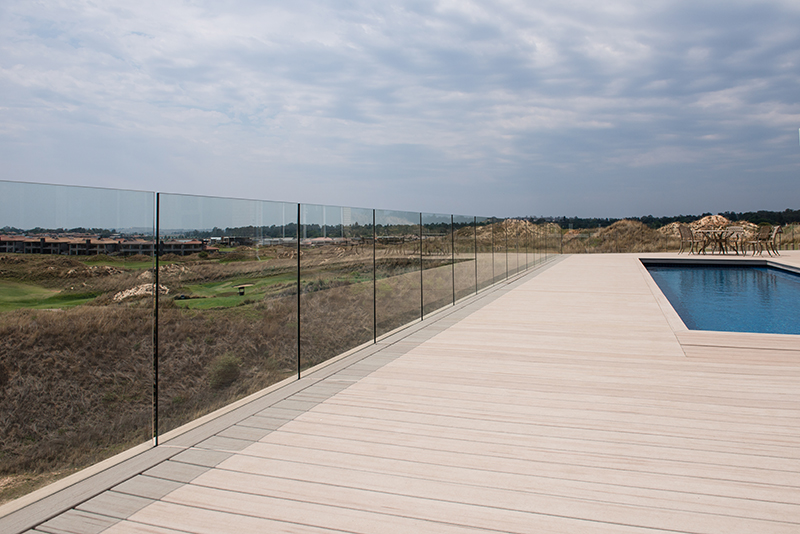
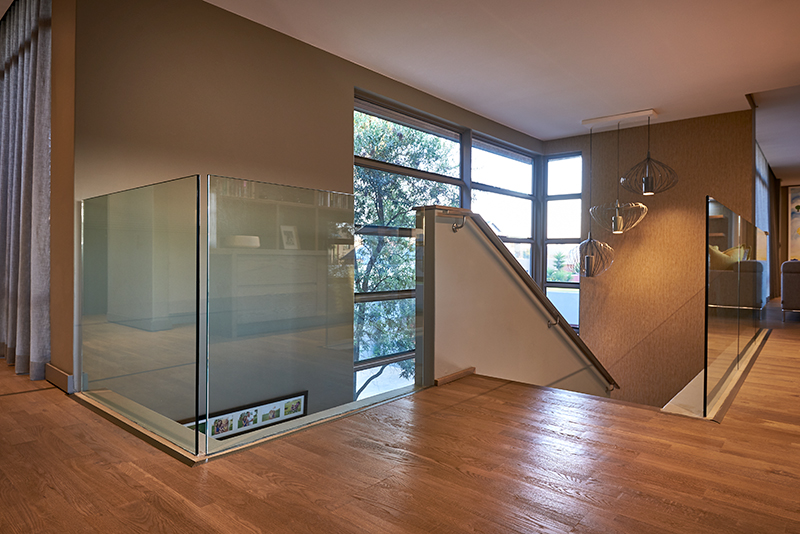
    “Building a new home from scratch is not an easy task. The burden of making sure that everything is done properly and correctly by all parties involved takes its toll on one’s physical & mental wellbeing. That is why when I encountered Yash & Hendri from Steel studio, it felt like a huge burden had been taken off my shoulders. While searching on the internet for installers of steel balustrades for my new home at Waterfall City, I came across Steel studio. I spoke to Yash who immediately allayed my fears & worries. He was entirely professional and extremely polite and helpful. Yash came over to my place, gave me a quotation & ensured that I was getting the best service available from the industry. We had steel balustrades installed on our balcony outside, on our staircase inside the house as well as glass balustrades installed around our pool area. We had an additional security gate installed to prevent our little kids from accidentally falling down the stairs. The entire process was quick, easy & extremely convenient, thanks to Yash & Hendri. And it was the cheapest of all the quotes I had received from other installers & manufacturers of steel balustrades. Well done guys & keep up the good work”. S.Desai, October 2018

    Choose a stainless steel balustrade that last forever. Speak to one of our qualified sales executives on 011-608-1963 or email sales@steelstudio.co.za. Let us help you design a balustrade that will not only achieve your aesthetic requirements but will also ensure your safety.

    PS: Always go to an expert when working with stainless steel. You’ll be glad you did.

    Filed Under: General News

    New technology in steel formwork for staircases transforms the SA construction industry

    November 7, 2018 by inbound

    Learn how steel formwork for staircases saves contractors expensive labour costs and delivers a product with unmatchable features

    Believe it or not, steel formwork for staircases has been around for centuries. Not only that, but the art of pre-casting a concrete structure like a staircase goes all the way back to early examples of concrete forms like arches and domes built by roman engineers. Back then, traditional materials to create formwork consisted of timber and plywood. In a very time-consuming process the outline of the structure was built and formed with these materials. Once the formwork was completed, the form was filled with concrete and only after the concrete had cured, the timber and plywood would be removed to reveal the cast structure.

    This technology of pre-casting forms has been used in countries where labour is typically inexpensive and has been practiced in the South African construction industry for centuries.

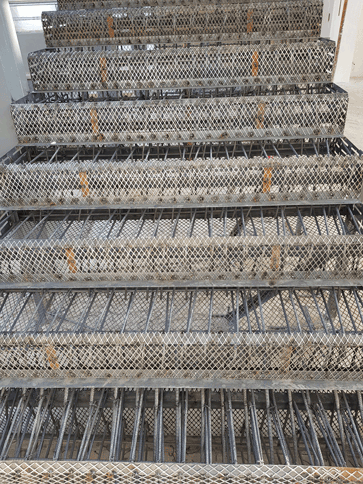
    Although, during the last couple of years, with the increased sizes of commercial buildings and structural engineering requirements, including the cost of manual labour and materials to create an off shutter structure like a staircase, contractors are looking to do more productive work with their labour force and save time on pre-cast structures that could be outsourced at a fraction of the price. As a result, Steel Studio now offers their recently launched permanent Steel formwork for staircases and have saved contractors a lot of money in a very competitive marketplace and consequently changing the construction industry in many ways. This product is a permanent structure. Fabricated and manufactured out of steel to the exact design of the staircase which is placed and fixed to the area after which the contractor fills the structure with concrete. No temporary materials like timber or plywood is necessary to achieve the staircase design.

    Some noticeable benefits of Steel Studio’s formwork for staircases are:

    1.Permanent steel formwork for staircases that is lightweight and easy to work with:

    steel form work being installed in a new building project

    The permanent formwork is a lightweight structure that can easily be rigged and manoeuvred into place on site by skilled installation teams.

    2.Complex and modern staircases are achieved with precision fabrication:

    Modern and complex staircase designs are achieved by the precision fabrication and laser cutting of the steel that is used to manufacture the formwork. Accuracy in measurements ensures that we are able to produce a staircase that is within tolerance and a superior quality finish.

    3.Effortless staircase construction for contractors:

    With no engineering and design done by the contractor, these systems enable the contractor to pour concrete effortlessly into the supplied steel formwork and be assured of the structural capabilities of the formwork. This product also eliminates over ordering of concrete and plaster.

    4.Staircases that save clients and contractors money:

    Expensive on site, manual shuttering time is eliminated from the project program where typically what would take a couple of weeks for manual shuttering can now be done in a couple of hours installation by a professional.

    5.New technology delivers state of the art staircases in Commercial buildings:

    Latest technologies and cleverly engineered solutions enable us to manufacture and install steel formwork for staircases on some of the largest commercial projects in South Africa.

    6.Staircases that buy Contractors crucial time on site:

    By using the right concrete MPa strength (Steel Studio specifies 40 MPa), concrete will set within 24 to 48 hours, enabling contractors to walk on the staircase structure, although it is important to keep heavy equipment clear from this area until fully cured in 28 days.

    7.Finally a staircase that gets approved before manufacturing – know what you’re buying

    Clients are supplied with architectural drawings including renderings for approval before manufacturing commences. This enables the client to see exactly what they will be getting and takes the guessing work out of the design of their new building.

    8.Rebar installation is part of the staircase package:

    What makes it even easier for you as the contractor is that Steel Studio will prepare a rebar schedule in consultation with a professional structural engineer and will insert the rebar before you have to pour concrete. Rebar is included in your staircase quotation. This way we can ensure that the staircase is structurally sound and that we can have the structure signed off by a structural engineer.
    All you have to do once we have installed the formwork and the rebar is to prop the steel formwork before pouring and based on the quantities and specifications of the concrete that our qualified project manager gives you, you can order and pour the concrete when you are ready.
    Contractors on site can walk up this staircase only a day after the concrete has been poured which leaves you with hardly any down time.

    This steel formwork for staircases is made from laser cut, mild steel panels that are precision cut and manufactured to the exact shape of your staircase design. Steel Studio can build a staircase from an architectural drawing provided by a professional or a custom staircase design can be drafted for the client.

    View our staircase product page for information on available designs and recently completed steel formwork for staircases https://www.steelstudio.co.za/steel-cage-formwork-staircases/

    Testimonials: Here’s what some of our recent satisfied clients have to say about their new staircase installation:

    “In terms of building our dream house, Steel Studio helped us to conceptualise one of the most important aspects of our house being our feature floating concrete stairs and glass balustrade. Having finalised the design Steel Studio executed the build and end-to-end completion of our staircase and wood / glass bridge with total professionalism and passion for excellence. Thanks Steel studio for a great building experience and awesome end product” – Paul Bowes – October 2018

    “Getting onto the website, seeing the examples on the gallery, sold my heart. I immediately made an enquiry, and my phone rang after 15 minutes. The consultant came to my house to do measurements, and the following day I had my quotation on my email. I immediately paid and my staircase was looking beautiful in a day. I have recommended this company and its services to some of my friends. Everyone who visits my home, wants them. I have given so many people the numbers to enquire. I don’t have a picture right now to show you how beautiful my house looks” – Violet Shai – October 2018

    Speak to one of Steel Studio’s qualified sales executives about how our steel formwork for staircases can transform your living space and save you time and money.
    PS: Don’t forget that we also offer a compatible and safe balustrade system for your new staircase.

    Call us now on 011-608-1963 or email sales@steelstudio.co.za.

    Filed Under: General News

    Here’s why the price of your frameless glass balustrades shouldn’t be your main concern.

    October 10, 2018 by inbound

    What your new frameless glass balustrade is going to cost you is important but even more importantly, the 3 questions you have to ask your supplier are:

    • How safe is your glass balustrading and will it protect those that utilise my building?
    • What methods of testing do you perform to ensure the safety of your balustrades?
    • Do you supply a Form 3 Engineers sign off on completion of my project?

    In today’s uncertain economy, as a new home builder the likelihood that you are looking to save costs wherever you can is expected. Especially when you are having to choose architectural hardware and finishes for your new home that come in a variety of designs and prices. And as a result, you may find yourself looking at the bottom line of a quotation instead of at the contents of what you are actually getting for the price. This could leave you with a product that is not what you initially expected and could even pose as a safety risk.

    The really good news, though, is that we have put together 3 simple questions that you can ask your frameless glass balustrade contractor to provide answers to. These questions will assist you in understanding the competence level of your contractor and the safety of your railing system.

    How safe is your glass balustrading and will it protect those that utilise my building?

    Your balustrade contractor is required by law to design and test all of his systems in consultation with a professional structural engineer and SANS deemed to satisfy rules. This ensures that all of his railings comply and are safe for their intended use.

    What methods of testing do you perform to ensure the safety of your balustrades?

    • According to SANS all frameless glass balustrades need to undergo a 400 Joule soft body impact test.
      The below video shows an example of this test that is being performed on a frameless glass balustrade system with a stainless steel handrail:
    • Moreover, the system also needs to undergo a point load and line load test.
      The below video shows an example of a line load test being performed on a balustrade system:
    • Not only that, but the method of fixing the balustrade to the fixing surface including the chemical anchor or cementitious grout that is being used to fix the balustrade needs to be tested for its load performance capabilities. All of these tests need to be performed in the presence of a professional structural engineer.
      The below video shows how a load test is being performed on a variety of chemical anchor products to establish the performance of each product:
    Do you supply a Form 3 Engineers sign off on completion of my project?

    On completion of your balustrade project, your contractor needs to supply you with a Form 3. This form is a declaration by a competent person(professional structural engineer) appointed to design a component or an element of a system, from the National Building Regulations and Building Standards Act, 1977 (Act No.103 of 1977). Without this Form 3, you will not receive your occupancy certificate from your building inspector and you are not guaranteed of a balustrade system that will perform under impact

    Once you have established that your balustrade contractor is qualified to manufacture and install your frameless glass balustrade system, you can then compare the quotations of those qualified contractors in order to get the best price and service.

    Saving money initially on an inferior installation, could cost you a lot more than just a few rands in the long run. That’s why we encourage you to investigate elements that perform a safety function in your new home before buying a cheap product that won’t protect your family. It just might be the best investment you’ll ever make.

    Here’s what our most recent customers say about Steel Studio:

    • The professional attitude is exceptional. From the measurements that were taken to the finished product, everything was handled professionally and efficiently. This did not stop there. After the job had been done there was a backup and a check for any snags and if there were any it was taken care of immediately. Here’s the best part, the price. It beat every other quote and with companies that were not in business as long as Steel Studio.
      S Bhana – September 2018.
    • Thank you for competitive market prices and the workmanship.
      Regina Mlisa – September 2018.
    • The attention to detail and technical accuracy and compliance is exemplary.
      Michael Russwurm – September 2018.

    Call us today on 010 040 3720 for a free consultation with one of our qualified technical sales executives and rest assured with the installation of a safety tested and guaranteed frameless glass balustrade system.

    Filed Under: General News

    • «Previous Page
    • Page 1
    • Page 2
    • Page 3
    • Page 4
    • Page 5
    • Interim pages omitted …
    • Page 12
    • Next Page»

    Get A Quote Modal

    Request A Quote

      We specialise in the design, manufacture and installation of balustrades, staircases and pool enclosures in commercial and residential markets.

      • Home
      • Services
      • About
      • Blog
      • Contact
      • Privacy Policy

      Copyright © 2025 Steel Studio | All Rights Reserved | Managed by Famous Digital Media